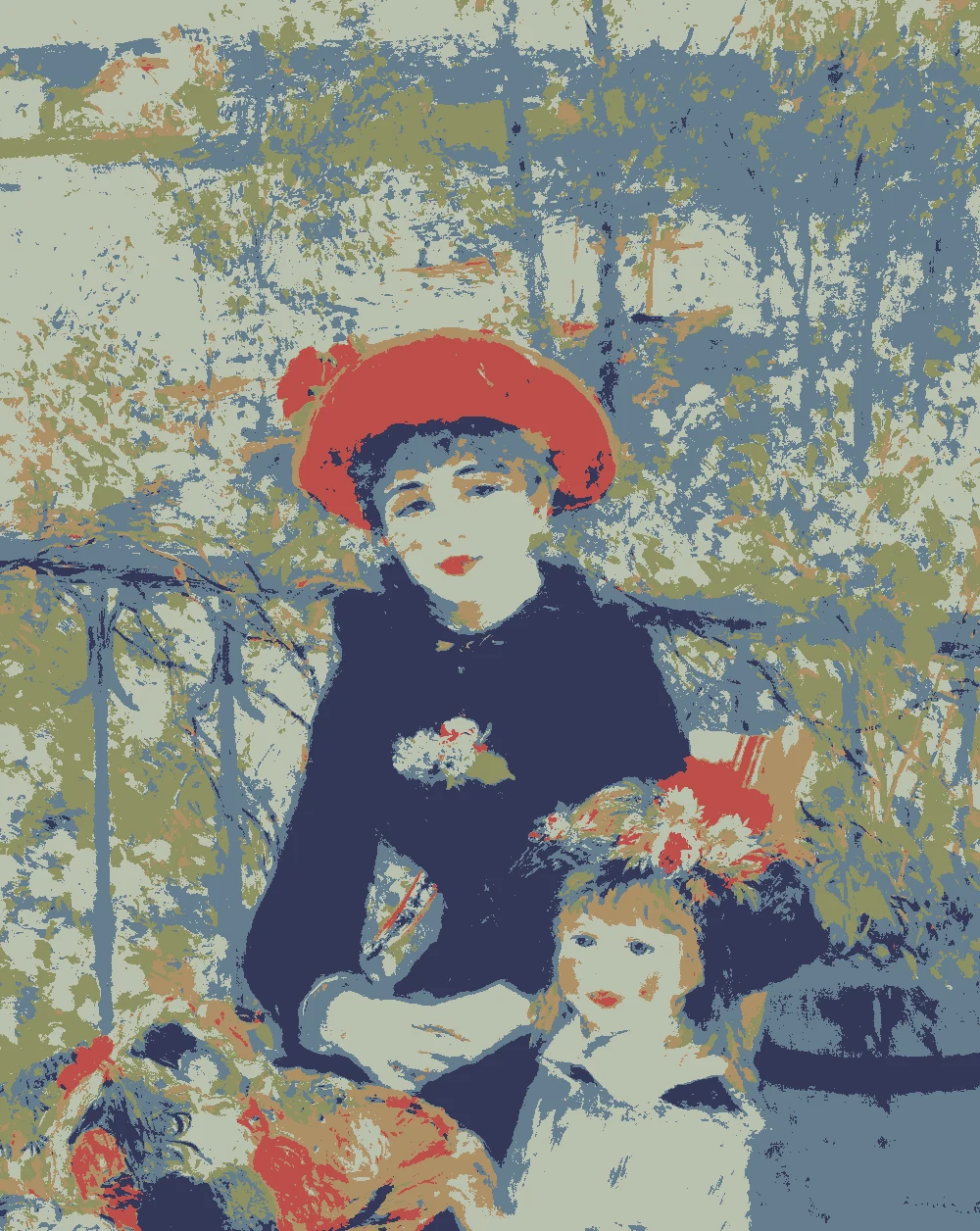
This palette comes from Edgar Degas's 1869 portrait Madame Théodore Gobillard (Yves Morisot, 1838–1893), held at The Metropolitan Museum of Art. It runs from warm cream to deep brown, with one muted green, and suits rooms that want a calm, earthy base.
Quick answer
Use the pale warm cream (LRV 68) on the walls. Make the sandy tan the main color on a second wall or large upholstered pieces. Use the deep walnut for doors, trim, or a single accent wall, and the honey wood tone for floors or wood furniture. Keep the muted sage for small textiles like cushions or a throw.
Edgar Degas, Madame Théodore Gobillard (Yves Morisot, 1838–1893), 1869.
The Metropolitan Museum of Art, open access.
The bar shows each color's measured share of the canvas.
The 6 colors in this painting
Measured from the image and ordered by how much of the canvas they cover. LRV is how much light a color reflects, from 0 for black to 100 for white.
Very dark warm brown
#4E4230 · 29.8% · LRV 6
Warm sandy tan
#BE9E71 · 29.6% · LRV 37
Deep walnut brown
#72593E · 15.7% · LRV 11
Honey wood tone
#9B754B · 12.1% · LRV 20
Pale warm cream
#F0D4A7 · 11.1% · LRV 68
Muted sage green
#929C64 · 1.7% · LRV 31
Where each color lives in the painting
Left, every pixel of the canvas snapped to its nearest palette color. Right, the detail where each color is strongest.
The same scene in 6 flat colors.
Very dark warm brownWarm sandy tanDeep walnut brownHoney wood tonePale warm creamMuted sage green
Closest paint colors
The nearest color from each brand. “Near-identical” and “Very close” are hard to tell apart on a wall; with “Similar”, compare a sample with the painting. Brands with nothing close are left out.
Paint names belong to their brands. Matches are measured from screen colors and are approximate; Light & Pigment is not affiliated with any paint brand.
How pale warm cream looks in your light
The wall color shifted for the light it will live in. Check the version closest to your room before buying a sample.
North-facing room#D2C4AB
North light is cooler and softer, so the warm yellow undertones can look flatter. The pale cream at LRV 68 still reads light and bounces what little light there is. Pair it with white trim to keep the room bright.
South-facing room#F3D8AC
Strong south light lifts the warm tones and can make the cream look almost bright. The sandy tan at LRV 37 holds its color well in this light. Check the deep walnut in the sun, since it can look richer and warmer than expected.
Evening, warm lamps (2700K)#CAAB7D
Warm evening bulbs push the yellow undertones forward, so the room will feel cozy and amber. The honey wood tone and sandy tan will look especially warm. The sage may appear slightly greener next to them, so test it under your own lamps.
Try the palette in a room
Pick which painting color goes on the walls, the big furniture and the bold piece. Floors, shadows and light follow your choices.
Wood takes Honey wood tone and the rug border takes Muted sage green in every combination.
Mood board
Details from the painting next to the colors and materials that carry them into a room.
Pale warm cream
Warm sandy tan
Deep walnut brown
LinenOiled oakLime plasterAged brass
Save this palette
A card with the painting, all 6 colors and a room scheme. Pin it, or take it to the paint store.
The very dark brown has an LRV of 6, so it reads close to black. Use it in small areas, such as a built-in, a door, or one accent wall. Keep the walls around it in the pale cream to avoid a closed-in feeling.
Which color should I use in a small room?
Use the pale warm cream as the main wall color. Its LRV of 68 reads light and helps a small room feel open. Add the sandy tan or walnut only in small amounts, such as a door or a single piece of furniture.
How much of the sage green should I use?
The sage makes up only about 1.7 percent of the canvas, so keep it as a light touch. A throw, a pair of cushions, or a small rug is enough. Too much of it can pull the room away from the warm palette.
Image: The Metropolitan Museum of Art, Public domain (CC0).
Palette, posterized image, details and room views generated by Light & Pigment from that image.
Colors look different on screen than on a wall, so always test a sample.