Sage Green Complementary Colors, Taken from Real Paintings
Sage green looks best with warm colors: cream, gold-brown, red-orange brown and a near-black. Every pairing here was measured from paintings where these colors share a canvas with two sage greens, so the painters did the matching.
Quick answer
Use warm cream on the walls, deep sage on the main furniture, gold-brown on wood and red-orange brown for one bold piece. Put the soft sage in textiles.
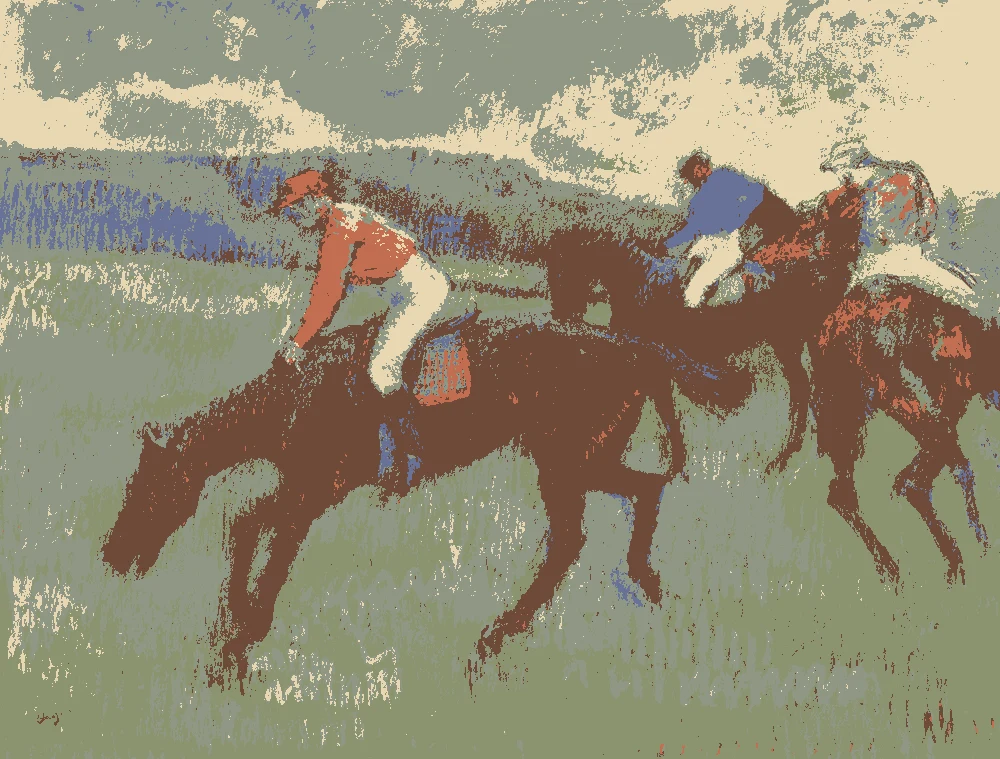
Every color on this page was measured from one of these public-domain paintings.
Shades of sage green
#8F9785LRV 30
Soft Sage Green
A mid-tone with a green undertone and an LRV of 30, so it adds color without feeling heavy. Use it for curtains, cushions or a bedroom wall with good daylight. Measured from Degas's "Three Jockeys."
With an LRV of 19, it reads darker and calmer than the soft sage. It suits a sofa, cabinet or lower wall that needs weight. Measured from Schreyer's "Man with Lance Riding through the Snow."
A deep red-orange brown with an LRV of 9, and the strongest contrast to green here. Use it for one bold piece such as a chair, a door or a rug border. Measured from Degas's "Three Jockeys."
A very light, warm yellow cream with an LRV of 70 that bounces light around the room. Use it on walls, or on trim and ceiling for a soft look. Measured from Degas's "Three Jockeys."
A very dark, warm brown with an LRV of 4. Keep it to small details like hardware, lamp bases or frames, where it sharpens the edges of the scheme. Measured from Schreyer's "Man with Lance Riding through the Snow."
A mid-tone with a warm yellow undertone and an LRV of 19. It echoes warm wood, so use it for table legs, shelves or a floor with a yellow cast. Measured from Schreyer's "Man with Lance Riding through the Snow."
The same paint reads differently in cool north light, warm south sun and under evening lamps. Find the column closest to your room.
Color
Neutral daylight
North light
South light
Evening lamps
Soft Sage Green
Warm Cream
Try these colors in a room
Pick which color goes on the walls, the big furniture and the bold piece. Floors, shadows and trim follow your choice.
The framed picture on the wall is Three Jockeys.
How do you choose between these two sage greens?
Start with how much light you want the room to keep. The soft sage, #8F9785, has an LRV of 30. It is a mid-tone that still reflects some light. The deep sage, #747D68, has an LRV of 19, so it absorbs more light and reads darker and moodier. Both have a green undertone, so they sit together without clashing.
Use the soft sage where you want color without heaviness: a textile, curtains, or a bedroom wall with good daylight. Use the deep sage on a larger piece such as a sofa, a cabinet or a lower wall, where the darker value gives the room an anchor.
If you can only pick one for the walls, choose by room size. A small, dim room will feel smaller in the deeper shade. A large room with big windows can carry it. In the suggested scheme, the deep sage goes on the main furniture, the soft sage on the textile and the warm cream on the walls.
What color combinations go with sage green?
The pairings here come from the same canvases as the greens, so they are all warm. The cream, #E9D8B3, has an LRV of 70 and a warm yellow undertone. It works on walls, and it also works as trim and ceiling if you want a soft, low-contrast look. The closest matches measured are Sherwin-Williams SW 6393 Convivial Yellow, Behr S310-2 Journal White and Farrow & Ball No. 67 Farrow's Cream.
For wood and flooring, the muted gold-brown, #8E764F (LRV 19), suits warm wood tones such as table legs, a frame or a floor stain with a yellow cast. The red-orange brown, #6E4A38 (LRV 9), is the bold piece: a leather chair, a door or a rug border. Red-orange sits opposite green on the color wheel, so it gives the strongest contrast.
Keep the near-black, #3E352F (LRV 4), for small details like hardware or a lamp base. In small amounts it sharpens the whole scheme.
How does sage green change in the light of a room?
LRV tells you how much light a color bounces back. The cream at 70 reads light and lifts a room. The soft sage at 30 sits in the middle. The deep sage and the gold-brown, both at 19, read dark. The red-orange brown at 9 and the near-black at 4 read very dark.
In a room with strong daylight, the greens keep their green undertone and look fresh. In a dim room, expect the mid-tones to look deeper than the chip, and the green may look grayer. Warm bulbs push the cream and gold-brown toward yellow and make the red-orange brown richer. Cool bulbs pull the greens toward gray.
Think about when you use the room. A living room used in the evening mostly sees lamplight, so judge the colors under your lamps. A kitchen used in the morning should be checked in morning sun. Look at each color on the darkest wall and on the brightest one.
How do you test a sage green color palette?
Paint large samples, not small dabs. Use boards about two feet square, or paint sheets of poster board, and move them around the room. Tape a sample next to the trim color, the floor and the biggest piece of furniture it will sit near.
Check each sample three times: in morning light, in afternoon light and under your evening lamps. Colors close in value, like the two sages, can be hard to tell apart on a small chip, so put them side by side.
Remember that the paint matches on this page are the closest measured, not exact copies. Some are near-identical, some very close and some only close, such as Valspar 2011-6 Cowboy Suede for the red-orange brown and Farrow & Ball No. 256 Pitch Black for the near-black. Buy a sample pot of the specific match you like. Treat the hex values on a screen as a rough guide only, since screens vary.
Leave the samples up for a couple of days before you decide.
FAQ
What colors go with sage green?
Warm cream, muted gold-brown, red-orange brown and a near-black brown all share a canvas with sage in these paintings. Cream suits walls and trim, and the browns suit wood, furniture and accents.
What is the complementary color of sage green?
Red-orange sits opposite green on the color wheel. The closest color here is the red-orange brown, #6E4A38, with an LRV of 9. Use it for one bold piece rather than a whole wall.
Can I use both sage greens in one room?
Yes. They share a green undertone, and their LRVs of 30 and 19 give you a lighter and a darker value. Put the soft sage in textiles and the deep sage on larger furniture.
What trim color goes with sage green walls?
The warm cream, #E9D8B3, is a gentle choice. With an LRV of 70 it reads light against the greens, and its yellow undertone matches the warm browns. For more contrast, use the near-black on small details only.
How do I compare a named sage, such as Saybrook Sage or Svelte Sage, with these colors?
Look up the LRV and undertone of the paint you are considering. If it is a mid-tone with a green undertone near an LRV of 19 to 30, the warm companions on this page are a good starting point. Always confirm with a large sample in your own light.
Save these colors
A card with every color on this page, its LRV and the paintings it comes from. Pin it, or take it to the paint store.
Painting images: The Metropolitan Museum of Art, The Art Institute of Chicago, public domain (CC0).
Colors measured by Light & Pigment. Paint names belong to their brands and matches are approximate. Colors look different on screen than on a wall, so always test a sample.

 From Three Jockeys, Edgar Degas