A white with a hint of grey looks softer than pure white and brighter than a true grey. These shades were measured from paintings, so each comes with its LRV and undertone.
Quick answer
For walls, use the pale blue-white #D5E7E6 or the warm white #E2E0D3, and add the greys #A7A7A7 and #7E7E7E on furniture or trim.
Every color on this page was measured from one of these public-domain paintings.
White and grey
#E2E0D3LRV 74
Greige white
A very light white with a warm yellow undertone at LRV 74, from Reynolds's portrait of Anne Dashwood. The closest match measured is Sherwin-Williams SW 6161 Nonchalant White.
Sherwin-Williams SW 6161 Nonchalant White
Near-identical
Farrow & Ball No. 252 Pavilion Blue
Very close
#D5E7E6LRV 77
Frost white
A very light white with a cool blue undertone at LRV 77, from George Hitchcock's The Annunciation. It is the suggested wall color and reads as a white that leans grey-blue.
The same paint reads differently in cool north light, warm south sun and under evening lamps. Find the column closest to your room.
Color
Neutral daylight
North light
South light
Evening lamps
Greige white
Frost white
Light pewter grey
Pale periwinkle
Try these colors in a room
Pick which color goes on the walls, the big furniture and the bold piece. Floors, shadows and trim follow your choice.
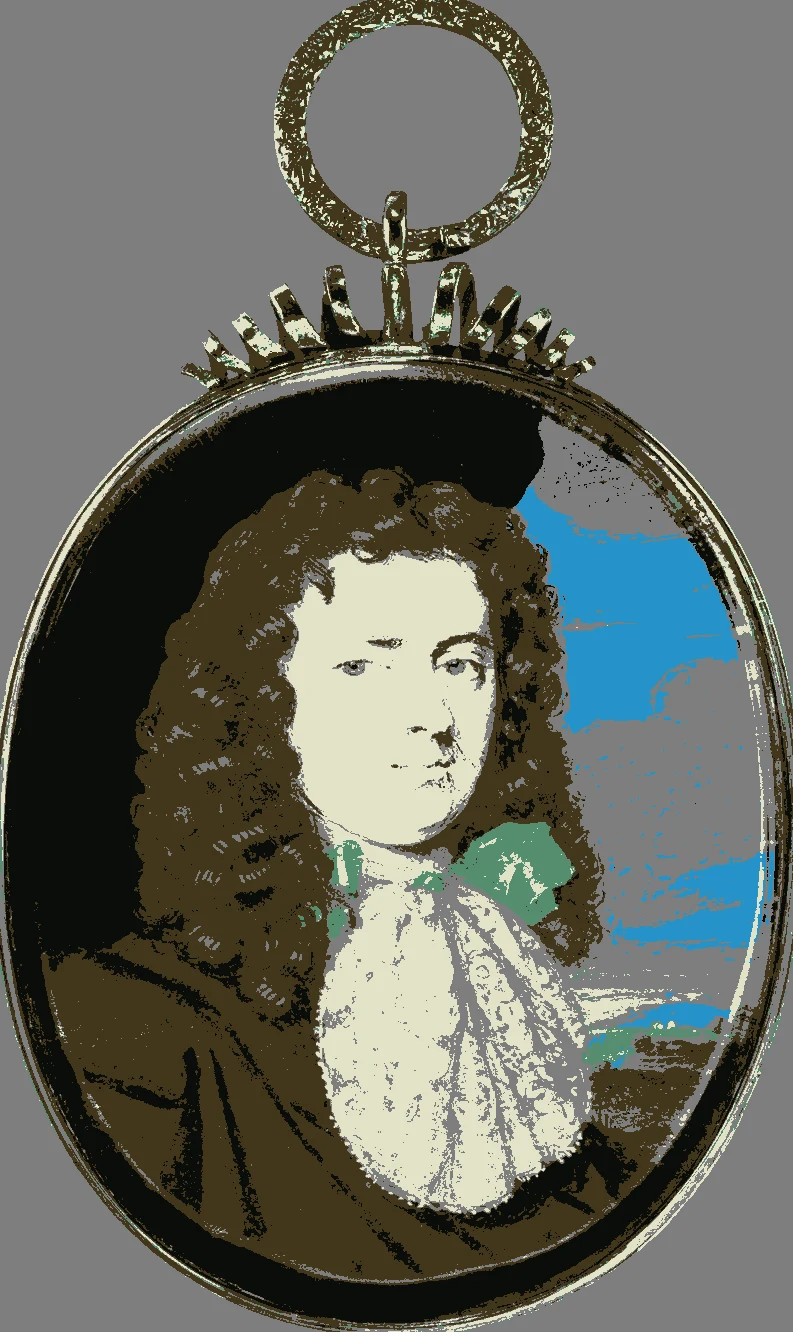
The framed picture on the wall is Anne Dashwood (1743–1830), Later Countess of Galloway.
What makes a white look slightly grey?
A white reads as grey when its LRV drops a little and its undertone is weak. The shades here sit between LRV 74 and 77, which is still very light. That is why they feel white but not stark.
The undertone decides the mood. The frost white #D5E7E6 has a cool blue undertone, so it feels crisp and fresh. The greige white #E2E0D3 has a warm yellow undertone, so it feels soft and a little creamy.
Compare the two against a pure white ceiling. The difference is easy to see, and it helps you decide whether you want a cool or a warm room.
Do not judge a white by itself. Look at the greys in the same room. The neutral grey #A7A7A7 has an LRV of 39, so against it the frost white looks even brighter and the greige white looks warmer than it did alone.
How do I use white and grey on walls and trim?
One option is white walls with grey trim. Paint the walls #E2E0D3 or #D5E7E6 and the trim #A7A7A7. The grey frames the windows and doors and keeps the room from looking washed out.
Another option is to reverse it: grey walls with a white that has a hint of grey on the trim and ceiling. Use the slate #7E7E7E on one wall only, since it has an LRV of 21.
Because the trim color is darker than the wall, it will show scuffs less. Use a satin finish on trim and a flat or matte finish on walls.
The brown #5F553C can also be a good trim or door color if you want the warmth of wood. At LRV 9, it contrasts strongly with the whites, so use it where you want a clear outline, such as around a fireplace or on a door.
How do these colors behave in different light?
Cool whites show their blue in north light and can feel cold. If your room faces north, choose the warm #E2E0D3 and use the greys sparingly.
In south light, a cool white such as #D5E7E6 stays clean and airy, because the sun balances the blue. The warm white can look yellow at midday, so test it before you commit.
In the evening, bulbs add warmth. A frost white may look closer to a plain white, and a warm white may look cream. Check your samples under the bulbs you use.
A room with several windows will mix light from different directions, so your samples may look different on each wall. Check the one in the darkest corner, since that is where a grey-white tends to look dullest, and move up to the lighter shade if needed.
How do I test a white with a hint of grey?
White paints are the hardest to judge from a small chip. Paint a large sample, about two feet square, and tape it up on two walls.
Hold a plain white sheet of paper beside the sample. The paper helps you see the tint. Look at the samples in the morning, at midday and at night.
Check the sample next to your floor, your trim and your furniture, since each of them changes how the white looks. If two shades are close, pick the one with the higher LRV for a small or dim room.
Painting a sample board and moving it around the room is better than painting patches on the wall, because you can see it in different light without the old color behind it. Do not forget to look at it next to your ceiling paint.
FAQ
What is a white with a hint of grey called?
Painters often call it an off-white, a grey-white or a soft white. On this page, #E2E0D3 and #D5E7E6 are the two closest shades, at LRV 74 and 77.
Is a grey-white warm or cool?
It can be either. #E2E0D3 has a warm yellow undertone and #D5E7E6 has a cool blue one.
What grey goes with white walls?
A neutral grey such as #A7A7A7 (LRV 39) works well for trim, furniture and rugs, and #7E7E7E (LRV 21) for details.
Will a white with grey look dirty?
Not if it is light enough. Both whites here have an LRV above 70, so they reflect most of the light that reaches them.
What finish should I use?
Flat or matte on walls hides flaws. Satin on trim is easier to wipe.
Save these colors
A card with every color on this page, its LRV and the paintings it comes from. Pin it, or take it to the paint store.
Painting images: The Metropolitan Museum of Art, The Art Institute of Chicago, public domain (CC0).
Colors measured by Light & Pigment. Paint names belong to their brands and matches are approximate. Colors look different on screen than on a wall, so always test a sample.


 From Anne Dashwood (1743–1830), Later Countess of Galloway, Sir Joshua Reynolds