Sage Green Front Door Colors, Shown on Real House Schemes
A sage green front door works best when its value and undertone suit the walls around it. Here are four sage and olive greens, each measured from a painting and shown on a complete exterior with wall, trim, shutter and roof colors.
Quick answer
Use a mid-tone sage with LRV 27 to 34 on the front door and shutters, pair it with pale or near-black trim, and match the wall undertone to your roof. Go a shade darker than you expect, because sun lightens exterior color.
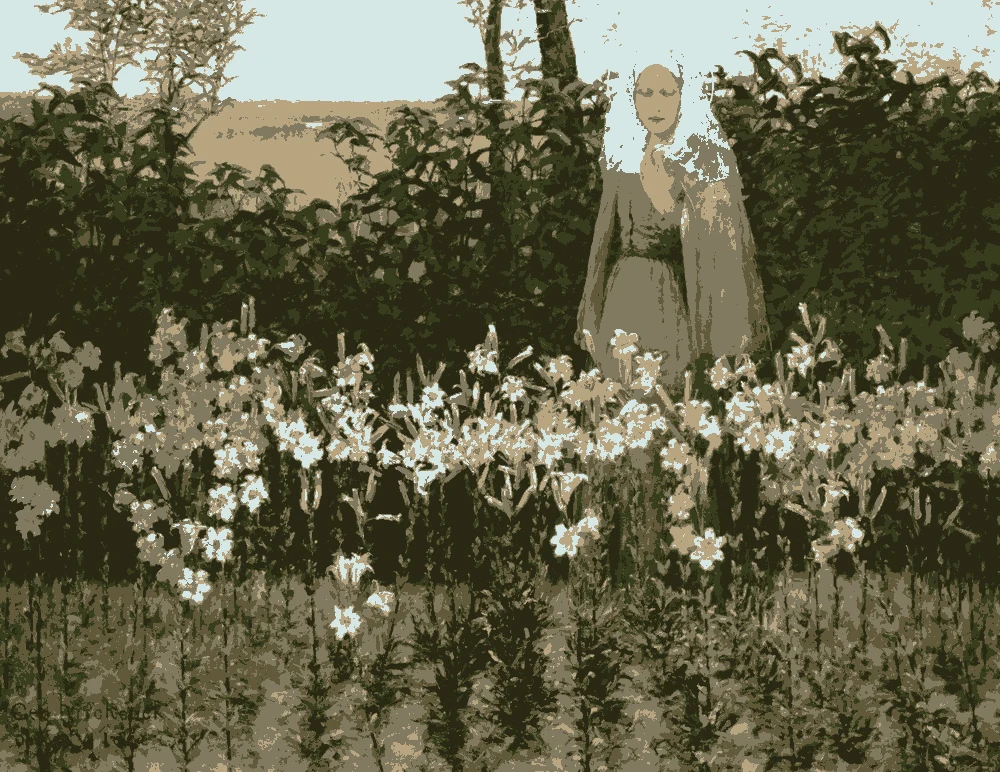
Every wall, trim and door color here was measured from one of these public-domain paintings.
4 complete exterior color schemes
Walls, trim, front door and roof together. Each scheme takes its colors from public-domain paintings, so the pairings are ones a painter already put side by side.
Dark Green Colonial
Walls #383D1E
Trim #D5E7E6
Front door & shutters #817A60
Roof: black
Very dark green walls with pale blue trim and an olive door and shutters suit a two-story colonial under a black roof. The trim outlines the house and the olive door adds a warm note.
Pale blue walls, near-black trim and a mid-tone sage door and shutters give a ranch a clean, high-contrast look under a black roof. The door is the only mid-tone, so it stands out.
Olive walls with pale blue trim and a light khaki sage door and shutters keep a farmhouse calm and earthy. The brown roof matches the warm undertone of the walls.
Deep red-brown walls with green-white trim and a mossy sage door and shutters suit a craftsman bungalow. The green door sets off the warm walls, and the brown roof fits the palette.
Exterior paint is seen in much stronger light than a room. Full sun bleaches a color by a shade or two, while the shaded side of the house and overcast days pull it cooler and darker. Test a large sample on two sides of the house.
Color
Swatch
Full sun
Overcast
In shade
Golden hour
Deep Forest Green LRV 4
Pale Blue White LRV 77
Barn Red Brown LRV 8
Pale Sage White LRV 73
Try these colors on a house
Pick a color for the walls, the trim, the front door and the roof, and switch between house styles. Shadows and siding lines follow your choice.
Roof colors are typical shingle, tile and metal colors, not paint. Every other color comes from a painting on this page.
Front door and shutter colors
#817A60LRV 19
Olive Door Green
A warm, yellow-leaning olive with LRV 19, so it reads very dark in shade and softens in sun. It is a strong front door on pale or very dark walls, and it comes from George Hitchcock's The Annunciation. Closest matches measured: Sherwin-Williams SW 7734 Olive Grove, Behr QE-37 Knotweed and Valspar 5008-2B Ironclad.
A mid-tone sage with a green undertone and LRV 34. It stands out clearly against pale walls and near-black trim, and it comes from Renoir's Alfred Sisley. Closest matches measured: Sherwin-Williams SW 7742 Agate Green, Behr N360-4 Battleship Gray and Farrow & Ball No. 81 Breakfast Room Green.
A light, warm sage with LRV 51 that suits a gentle door or shutters on deeper olive walls. Expect it to look paler in full sun. It comes from Van Gogh's Olive Trees. Closest matches measured: Sherwin-Williams SW 7747 Recycled Glass, Behr BNC-03 Essential Brown and Farrow & Ball No. 75 Ball Green.
A mid-tone green with LRV 27, a little deeper than the gray sage and a good partner for warm red-brown walls. It comes from Renoir's Near the Lake. Closest matches measured: Sherwin-Williams SW 2812 Rookwood Jade, Behr 780D-6 Witch Hazel and Farrow & Ball No. 34 Calke Green.
A very dark green wall color at LRV 4, with enough depth to make pale trim and an olive door stand out. It comes from George Hitchcock's The Annunciation. Closest match measured: Behr S-H-730 Eagle Rock.
A very light, cool blue-tinted color at LRV 77, used for walls on the ranch and for crisp trim on two other houses. It bounces plenty of light, and it comes from George Hitchcock's The Annunciation. Closest matches measured: Sherwin-Williams SW 6497 Blue Horizon, Behr HDC-WR15-5 Arctic Flow and Farrow & Ball No. 269 Cabbage White.
A deep red-orange wall color at LRV 8 that reads rich and warm, and it brings out the green in a mossy sage door. It comes from Renoir's Near the Lake. Closest matches measured: Sherwin-Williams SW 7591 Red Barn, Behr PPU2-02 Red Pepper and Valspar 1011-4 Posh Red.
A neutral near-black with LRV 1 and no clear undertone, good for trim, fascia and a garage door against pale walls. It comes from Govert Flinck's A Young Woman as a Shepherdess. No close commercial match was found, so sample a soft black from your paint maker.
A very light trim color with a green undertone and LRV 73. It is softer than a stark white and sits well next to a sage door and brown roof. It comes from Renoir's Near the Lake. Closest matches measured: Sherwin-Williams SW 6175 Sagey, Behr N310-2 Arid Landscape and Farrow & Ball No. 282 Shadow White.
How do I choose a wall color to go with a sage green door?
Start with what will not change. A roof, brick, stone, a concrete step or a stained garage door stays put, so the wall color has to work with it. Look at the undertone of those materials in daylight. A brown roof sits well with warm colors such as the olive #817A60 or the red-brown #774139. A black roof is easier to pair with the cool pale blue #D5E7E6 or the very dark green #383D1E.
If you have brick or stone you plan to keep, skip the wall color and choose only the door, shutters and trim. A sage door like #8FA390 or #879272 has a green undertone and usually sits well beside warm brick.
Then think about the look you want. Light walls such as #D5E7E6, LRV 77, make a house feel open and bright. Very dark walls such as #383D1E, LRV 4, make it feel solid and quiet, and they work best when pale trim defines the edges.
How much contrast should trim and a sage door have?
Contrast tells people where to look. On most houses the front door should be the clearest point of interest, so give it a different value from the walls and the trim.
Take the olive door #817A60, LRV 19, on very dark walls at LRV 4 with pale trim at LRV 77. The trim draws the outline and the door reads as a lighter, warmer note. Now take the sage #8FA390, LRV 34, on pale walls at LRV 77 with near-black trim at LRV 1. Here the door is the only mid-tone, so it stands out at once.
For a softer look, choose a door closer in value to the walls. The light khaki sage #C2BEA0, LRV 51, on olive walls at LRV 19 is a gentler step, though the pale trim still sharpens the edges.
Choose one place for strong contrast, not three. If the trim is stark against the walls, let the door be the quieter color. If the trim is soft, the door can carry more weight.
Why does exterior paint look different in sun and shade?
Paint looks different outside than on a small chip indoors. In full sun, an exterior color looks lighter and can wash out. In shade, it looks cooler and often a little grayer. The same color can look like two colors on two sides of one house.
Because of this, choose a shade darker than the one you think you want. A mid-tone sage like #8FA390, LRV 34, will read lighter on a sunny wall. On a shaded porch it may lean cooler and more gray-green. The olive #817A60, LRV 19, is already very dark, so it holds its depth in sun and may look nearly brown in deep shade.
Pale colors need care too. The pale blue #D5E7E6, LRV 77, bounces a lot of light, so in strong sun it can look very bright. The green-white #E0DFCD, LRV 73, is softer for trim. If your front door sits under a deep porch roof, a slightly lighter sage can keep it from disappearing.
How do I test sage green paint on my house?
Test large samples, not small chips. Paint a board or a piece of primed poster board about two feet square, with two coats, so you see the true color without the old paint showing through.
Tape the samples on at least two sides of the house, for example one in sun and one in shade. Look at them in the morning, at midday and in the evening, and again on a cloudy day. A sage can look green at noon and gray at dusk.
Hold each door sample next to your trim sample and beside the roof, brick or stone that will stay. Place a wall sample next to the door sample, since the pair matters more than either color alone. Leave the samples up for several days before you decide.
Finally, check the color from the street. That is how most people will see your door, and it is often different from the view at arm's length.
FAQ
What color trim goes with a sage green front door?
A pale trim with LRV 73 to 77, such as the green-white #E0DFCD or the pale blue #D5E7E6, gives a clear outline. A near-black trim at LRV 1 gives the strongest contrast against light walls.
What roof color goes with a sage green door?
The schemes here pair black roofs with cool or very dark walls and brown roofs with warm olive or red-brown walls. Match the roof's undertone to the walls first, then choose the door.
Is sage green a good front door color for a brick house?
Yes, usually. A mid-tone sage with a green undertone, like #8FA390 or #879272, sits well beside warm brick. Test it next to the brick in daylight, because the brick's undertone changes how the green reads.
How light or dark should a sage green front door be?
The doors on this page run from LRV 19 to 51. A mid-tone near LRV 27 to 34 is easy to see against pale walls, while LRV 19 reads very dark and LRV 51 reads light and soft.
Will sage green look different outside than on the paint chip?
Yes. Sun makes exterior color look lighter and shade makes it look cooler. Choose a shade darker than you expect and test large samples on two sides of the house.
Save these colors
A card with these house color schemes: walls, trim, front door and roof. Pin it, or take it to the paint store.
Painting images: The Art Institute of Chicago, The Metropolitan Museum of Art, public domain (CC0).
Colors measured by Light & Pigment. Paint names belong to their brands and matches are approximate. Colors look different on screen than on a wall, so always test a sample.