Gray and White House: Exterior Colors for Walls, Trim and Door
A gray and white house works when the gray has the right undertone for your roof and surroundings and the white trim frames it cleanly. Here are four complete exteriors, each with a wall color, white trim, front door and shutter color, and a roof color.
Quick answer
Use a gray with LRV 33 to 67 on the walls, the soft white #E8E8E8 on trim, fascia and garage door, and a deeper color on the front door and shutters. Pair the scheme with a charcoal or black roof.
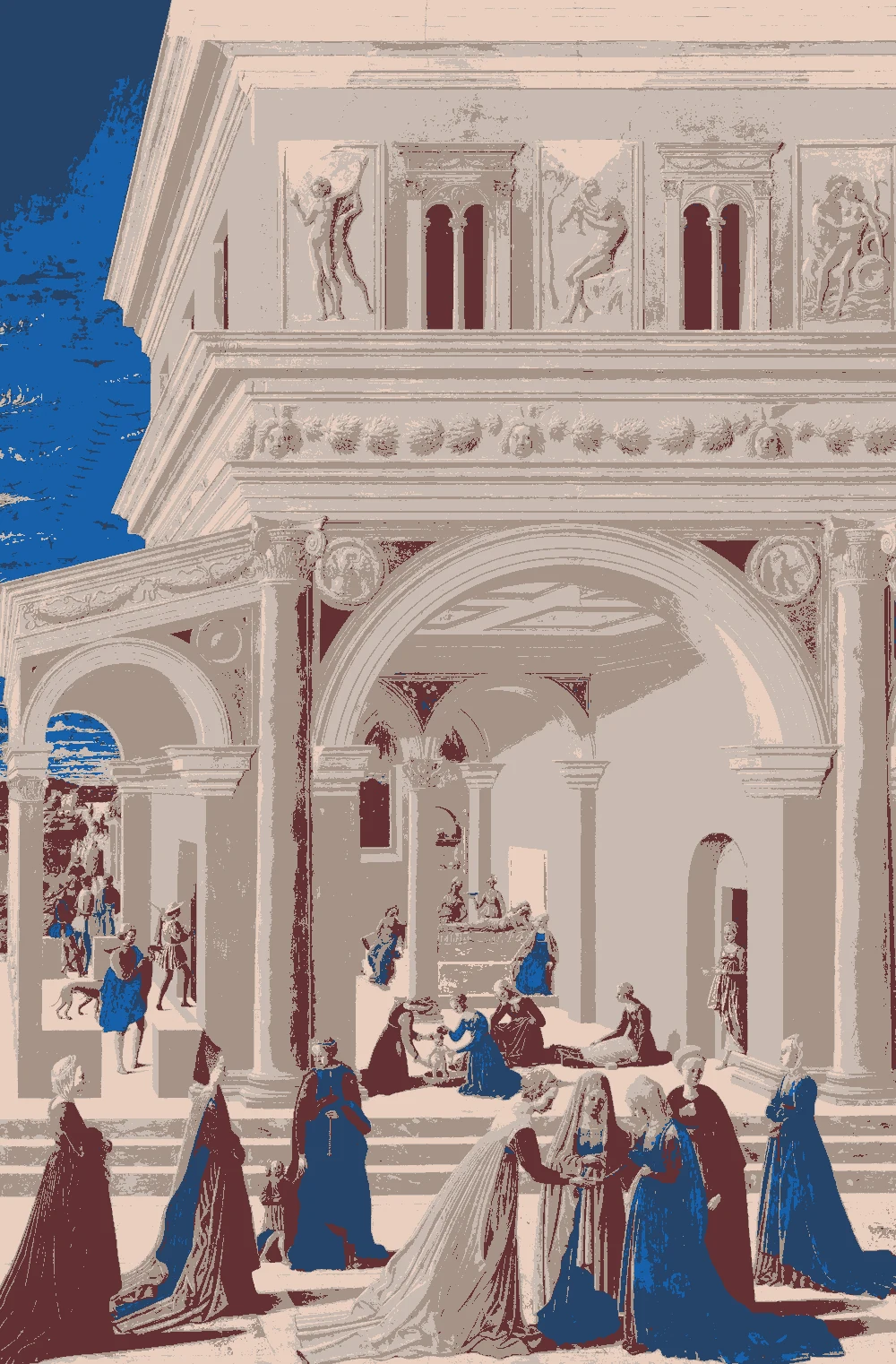
Every wall, trim and door color here was measured from one of these public-domain paintings.
4 complete exterior color schemes
Walls, trim, front door and roof together. Each scheme takes its colors from public-domain paintings, so the pairings are ones a painter already put side by side.
Warm Taupe Colonial
Walls #C8BAB2
Trim #E8E8E8
Front door & shutters #8E4033
Roof: charcoal
Warm taupe walls with white trim, a deep red door and shutters, and a charcoal roof suit a two-story colonial. The red door is the one strong note on a calm front.
Pale green gray siding, white trim and a clay coral door and shutters brighten a low ranch under a black roof. The light wall keeps a long, low house from looking heavy.
A mid-tone sage gray with crisp white trim and a very dark brown door and shutters gives a farmhouse a strong, simple outline. A charcoal roof keeps the dark tones consistent.
Very light rosy gray walls with white trim and olive gold door and shutters show off the detail on a craftsman bungalow. The black roof gives the pale walls a clear top edge.
Exterior paint is seen in much stronger light than a room. Full sun bleaches a color by a shade or two, while the shaded side of the house and overcast days pull it cooler and darker. Test a large sample on two sides of the house.
Color
Swatch
Full sun
Overcast
In shade
Golden hour
Warm Stone Taupe LRV 51
Misty Green Gray LRV 61
Soft Sage Gray LRV 33
Pale Rosy Gray LRV 67
Soft White Trim LRV 81
Try these colors on a house
Pick a color for the walls, the trim, the front door and the roof, and switch between house styles. Shadows and siding lines follow your choice.
Roof colors are typical shingle, tile and metal colors, not paint. Every other color comes from a painting on this page.
Colors for the walls
#C8BAB2LRV 51
Warm Stone Taupe
A light greige with a warm red-orange undertone and an LRV of 51, so it reads soft but not pale. Use it on siding or painted brick next to tan stone or a charcoal roof. It is measured from "The Birth of the Virgin" by Fra Carnevale, 1467.
A light gray with a green undertone and an LRV of 61, which keeps a small house bright. It suits a ranch or any house surrounded by trees and lawn. It is measured from "Icebound" by John Henry Twachtman, c. 1889.
A mid-tone gray with a green undertone and an LRV of 33. It holds its depth in strong sun and gives a large wall some weight, so it works on a farmhouse or a big two-story. It is measured from "Nocturne: Blue and Gold—Southampton Water" by James McNeill Whistler, 1872.
A very light gray with a pink-red undertone and an LRV of 67. In full sun it can look close to white, so use it where the light is softer or on a bungalow with plenty of trim detail. It is measured from "Houses of Parliament, London" by Claude Monet, 1900–1.
A very light neutral with no clear undertone and an LRV of 81. Use it on trim, fascia, corner boards and the garage door. It is measured from the "Mural Fragment Depicting a Maguey Bloodletting Ritual" by Teotihuacan, 500–600 CE.
A deep red-orange with an LRV of 10. Use it on the front door and shutters of a light taupe house, where it gives the strongest contrast. It is measured from the "Mural Fragment Depicting a Maguey Bloodletting Ritual" by Teotihuacan, 500–600 CE.
A mid-tone red-orange with an LRV of 26. It is friendlier than a deep red and looks good against a light green gray wall. It is measured from the "Mural Fragment Depicting a Maguey Bloodletting Ritual" by Teotihuacan, 500–600 CE.
A very dark brown with a warm yellow undertone and an LRV of 2, so it reads close to black. Use it on a front door or shutters for a sharp edge against white trim. It is measured from "Nuns at Work" by Alessandro Magnasco, and there is no close commercial paint match.
A mid-tone olive with a warm yellow undertone and an LRV of 21. It adds a soft, earthy accent to a very light wall without the weight of a dark door. It is measured from "Lion Hunt" by Eugène Delacroix, 1860–61.
How do you choose the wall color for a gray and white house?
Start with what will not change. A roof, a brick chimney, a stone foundation or stone steps stay as they are, so the wall color has to sit well beside them. Hold a sample next to each one before you look at anything else.
Next, look at the undertone. The four wall colors here lean in different directions. #C8BAB2 is warm and red-orange, so it suits tan brick, warm stone and a charcoal roof. #C3D0C7 and #9A9E93 lean green, which goes well with trees and lawns and with a black or charcoal roof. #DED2DA is very light with a pink-red lean, so check it against any red brick before you commit.
Then think about size. A mid-tone like #9A9E93, LRV 33, gives a large wall some weight. A light color like #C3D0C7, LRV 61, keeps a small ranch open and bright. Pick the wall shade first, then decide how much trim and door contrast to add.
How much contrast should white trim and the front door have on a grey house?
White trim does the framing. The trim color here is #E8E8E8, LRV 81, a very light neutral with no clear undertone. Against a wall at LRV 33 the contrast is strong and crisp. Against a wall at LRV 67 it is soft, so the trim reads as a gentle edge rather than a bold outline.
Use the same trim color on fascia, corner boards, window casings and the garage door. One white keeps the house calm, and the garage door stops pulling the eye away from the entry.
Give the front door the biggest contrast. A deep door such as #8E4033, LRV 10, stands out against a light taupe wall. A mid-tone door like #C87564, LRV 26, is warmer and friendlier. The very dark #36250F, LRV 2, reads almost black and looks sharp beside white trim. Shutters usually take the door color, which ties the front together. For a quieter look, paint the shutters the trim color and keep the color for the door alone.
Why do exterior colors look lighter in sun and cooler in shade?
Outdoors, color changes more than it does in a room. Full sun makes a color look lighter and often washes out the undertone. Shade and north-facing walls look cooler and darker, and green undertones show more.
So choose a shade darker than the one you like on the chip. A wall you love at LRV 61 may look close to white on a sunny south side. A color at LRV 33 holds its depth better in strong light and still looks soft on a shaded side.
Large surfaces also look lighter and stronger than a small chip. Siding, stucco and painted brick take color differently as well. Texture creates tiny shadows, so a rough surface can look a little deeper than smooth siding in the same color.
If your house sits under big trees, expect green undertones to look stronger. If it sits in open sun, expect a warm color like #C8BAB2 to glow. Neither is wrong. Just know which one you are choosing.
How do you test exterior paint samples on a house?
Test on the house, not on a board you carry around. Paint a sample at least two feet by two feet, or use a large sample board, and put one on two sides of the house: a side that gets full sun and a side in shade.
Look at each sample in the morning, at midday and in the evening. Check it on a cloudy day too if you can. View it next to the white trim sample, the roof, and any brick or stone. Do not judge the wall color alone. Set the door color near it as well.
Paint the sample on the same material as the house when you can. Painted brick and stucco will not look like smooth siding. Leave the samples up for a few days before you decide.
Last, look from the street. Stand where a visitor would stand and at the end of the driveway. From there, the balance of wall, trim and door matters more than small details.
FAQ
What color trim goes with a gray house?
White trim is the classic pairing, and the one used here is #E8E8E8, LRV 81. The closest matches measured are Sherwin-Williams SW 6252 Ice Cube (very close) and Behr PR-W8 Ambience White (near-identical).
Does a grey house with white trim need a colored front door?
It does not need one, but a door color gives the house a focal point. A deep red, a clay coral, an olive gold or a very dark brown each work with the grays shown here.
What roof color goes with a gray and white house?
A charcoal or black roof pairs with all four schemes on this page. Hold your wall sample next to a roof shingle, because the roof color is fixed and the wall undertone should sit comfortably beside it.
Should I choose a light or dark gray for the siding?
Light grays like #C3D0C7 (LRV 61) keep small houses bright and open. A mid-tone like #9A9E93 (LRV 33) holds up better in strong sun and suits larger houses. Remember that exterior colors look lighter in full sun.
Why does my gray paint look different on the house than on the chip?
Sunlight lightens a color, shade cools it, and a large wall looks stronger than a small chip. Test a large sample on a sunny side and a shaded side and view it at different times of day.
Save these colors
A card with these house color schemes: walls, trim, front door and roof. Pin it, or take it to the paint store.
Painting images: The Metropolitan Museum of Art, The Art Institute of Chicago, public domain (CC0).
Colors measured by Light & Pigment. Paint names belong to their brands and matches are approximate. Colors look different on screen than on a wall, so always test a sample.