Farmhouse Paint Colors: A Palette Measured from Paintings
This farmhouse color palette has six colors, each measured from a painting at The Art Institute of Chicago. It pairs a soft white and a warm cream with a stone gray, a sage gray green, a deep brown and a near black. Use the light colors on walls and the dark ones in small doses.
Quick answer
Use the pale white (LRV 74) on walls, the warm cream on a painted piece or trim, and the sage in textiles. Keep the deep brown for furniture and the near black for thin details.
Every color on this page was measured from one of these public-domain paintings.
The palette
#DAE0E5LRV 74
Soft Porcelain White
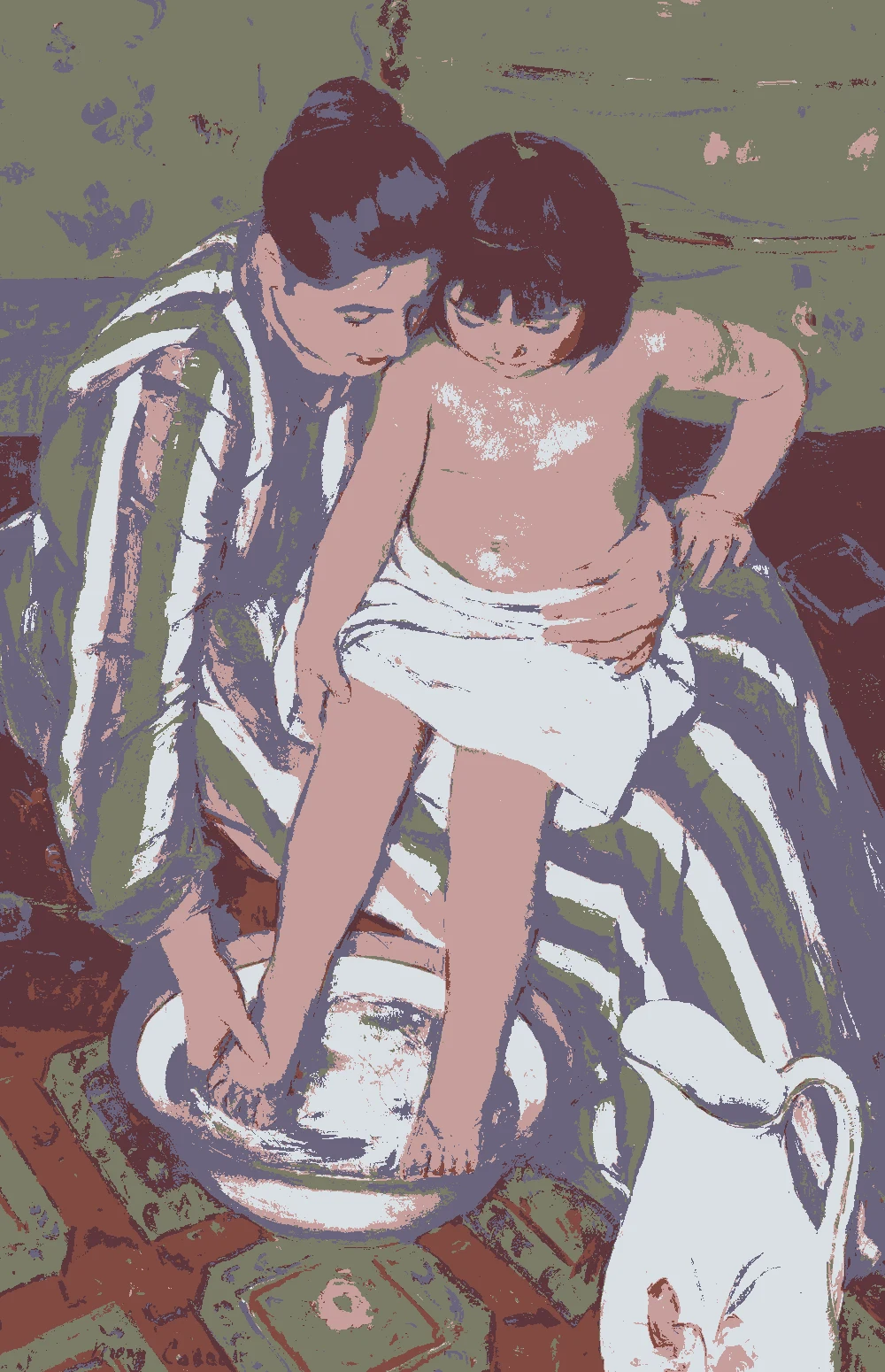
A very light, neutral white with no clear undertone and an LRV of 74, so it bounces light around kitchens, hallways and small rooms. Measured from Mary Cassatt's The Child's Bath (1893), it suits the main walls.
A light cream with a warm yellow undertone and an LRV of 65. Use it on a painted cabinet, a bench or the trim, where it adds warmth next to cooler walls. Measured from Renoir's Acrobats at the Cirque Fernando (1879).
A light, neutral gray with an LRV of 43. It works on a lower wall, a mudroom or a built-in when white feels too bright. Measured from Berthe Morisot's Woman at Her Toilette (1875-80).
A mid-tone with a green undertone and an LRV of 33. It suits curtains, cushions and throws, and it can also work on a cabinet in a room with good light. Measured from Whistler's Nocturne: Blue and Gold, Southampton Water (1872).
A very dark color with a warm yellow undertone and an LRV of 1. Keep it to window frames, light fixtures and hardware, where thin lines add contrast. Measured from Degas's Henri Degas and His Niece Lucie Degas (1875-76).
A deep brown with a warm red-orange undertone and an LRV of 14. It suits a dresser, a table base or a front door, and it takes in most of the light that hits it. Measured from Albert Besnard's Woman's Head (c. 1890).
The same paint reads differently in cool north light, warm south sun and under evening lamps. Find the column closest to your room.
Color
Neutral daylight
North light
South light
Evening lamps
Soft Porcelain White
Warm Parchment Cream
Soft Stone Gray
Quiet Sage Gray
Try these colors in a room
Pick which color goes on the walls, the big furniture and the bold piece. Floors, shadows and trim follow your choice.
The framed picture on the wall is The Child's Bath.
How do you choose between these farmhouse colors?
Start with the walls. The pale neutral white (LRV 74) is the lightest color here and bounces the most light, so it suits small rooms, hallways and kitchens with little sun. The warm cream (LRV 65) is nearly as light but has a yellow undertone, which reads softer. Choose the cream if the room gets cool north light.
Next, pick one mid-tone. The stone gray (LRV 43) is neutral and calm. The sage gray green (LRV 33) is darker and shows its green undertone more. Both work on a lower wall, a built-in or a mudroom.
Then add depth in small amounts. The deep brown (LRV 14) suits a dresser, a table base or a front door. The near black (LRV 1) belongs on thin things: window frames, light fixtures and hardware. A good rule is one light color, one mid-tone and one dark in each room.
What goes with farmhouse white paint: trim, ceiling and floors?
For trim, you have two easy paths. Paint it the same pale white as the walls for a soft, low-contrast look. Or use the warm cream on the trim against the cooler white walls, which adds a gentle edge without a hard line. A very bright, stark white next to these colors can make the walls look dull, so test it before you buy a gallon.
Ceilings work best in the lightest color, the pale white at LRV 74, or in the wall color. This keeps the room bright and stops the ceiling from feeling heavy.
For floors, mid-brown wood sits well beside the deep brown and the sage. Pale, weathered boards pair with the stone gray. Dark floors can echo the near black. Keep the deep brown for furniture and doors rather than large walls, because at LRV 14 it absorbs most of the light. Use the sage in textiles to link the walls to the wood.
How do these colors look in different light?
Light changes every color on this page. North-facing rooms get cooler, flatter light. The pale neutral white can look slightly cold there, so the warm cream or some brown in the furnishings helps balance it. South-facing rooms get warmer light, where the pale white stays crisp and the cream can look more yellow.
Colors with a low LRV lose more in shade. The sage at LRV 33 and the deep brown at LRV 14 look darker in a room with one small window. Use them where you have good light, or keep them to furniture and textiles.
Bulbs matter too. Warm bulbs push the cream and the brown toward yellow and orange. Cooler bulbs make the white look crisper and the sage look greener. Pick one bulb color for the room and judge your samples under it, in the evening as well as at noon.
How do you test farmhouse paint samples?
Test on the wall, not only on a small card. Paint a sample board about two feet square, or use a large peel-and-stick sample, and move it around the room. Look at it next to the trim, the floor and your largest piece of furniture.
Check each sample in morning, midday and evening light. Look at it on the wall that gets the most sun and on the one that gets the least. Colors with a low LRV change the most between those two walls.
Compare the sample with your real materials: wood, fabric, tile and countertops. The hex values here were measured from paintings, and screens vary, so treat them as a starting point. The paint matches listed are the closest ones measured. Buy a sample pot of each before you commit. For the near black, no close commercial match was found, so ask a paint store to color-match it from a physical sample.
FAQ
What are the best farmhouse paint colors?
This palette uses a pale neutral white, a warm cream, a stone gray, a sage gray green, a deep brown and a near black. Use the light colors on walls and the dark ones on furniture and small details.
What is a good farmhouse white paint?
The pale neutral white (LRV 74) is a clean, light choice for walls. The warm cream (LRV 65) has a yellow undertone and feels softer. The closest measured matches are Sherwin-Williams SW 6238 Icicle and SW 9119 Dirty Martini.
How do I build a modern farmhouse color palette?
Keep the walls pale and the contrast sharp. Use the white on walls, the near black on window frames and fixtures, and the deep brown on one or two pieces of furniture.
Can I use these colors for rustic, country, coastal or boho farmhouse styles?
Yes, by changing the balance. For rustic or country rooms, use more of the cream, deep brown and wood. For a coastal look, lean on the pale white and sage. For a boho look, bring in the sage and brown through textiles.
How dark should the dark colors be in a farmhouse room?
Use them sparingly. The deep brown has an LRV of 14 and the near black has an LRV of 1, so both absorb light. Limit them to furniture, doors, frames and hardware, and keep the walls light.
Save these colors
A card with every color on this page, its LRV and the paintings it comes from. Pin it, or take it to the paint store.
Painting images: The Art Institute of Chicago, public domain (CC0).
Colors measured by Light & Pigment. Paint names belong to their brands and matches are approximate. Colors look different on screen than on a wall, so always test a sample.


 From The Child's Bath, Mary Cassatt