Modern rooms rely on a small, calm palette: pale walls, a mid-gray, one deep accent and a few near-black details. These six colors were measured from public-domain paintings, and each one shows its LRV, undertone and closest paint matches.
Quick answer
Use pale gray #DAE0E5 on the walls, soft gray #B3AFAA on main furniture, dark brown #41382D for wood, slate blue #657E8D as the bold piece and warm linen #DED2C4 for textiles.
Every color on this page was measured from one of these public-domain paintings.
The palette
#DAE0E5LRV 74
Pale Mist Gray
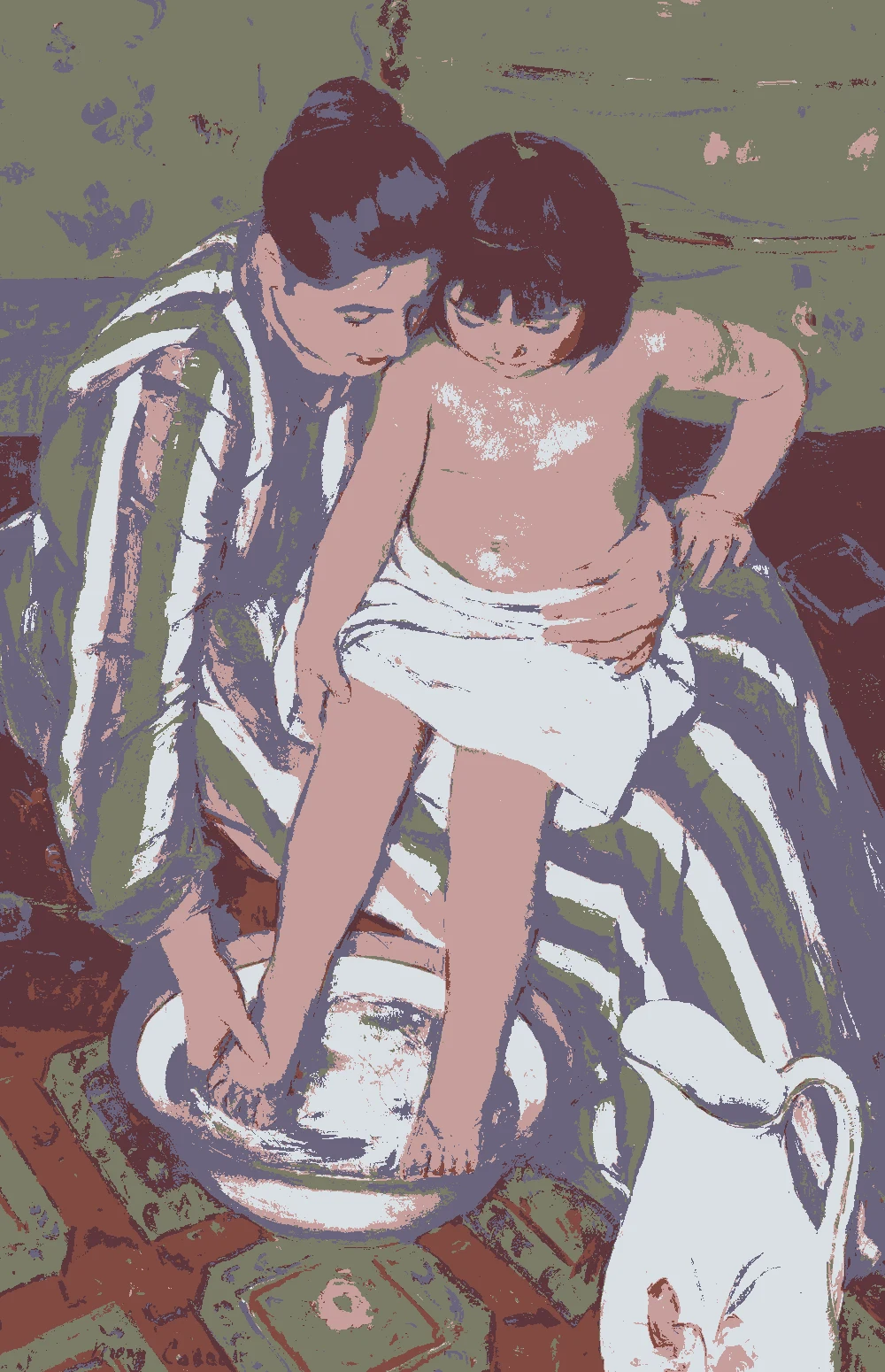
A very light, neutral gray with an LRV of 74, so it bounces light and works as the main wall color in living rooms, bedrooms and halls. It was measured from Mary Cassatt's "The Child's Bath" (1893, The Art Institute of Chicago).
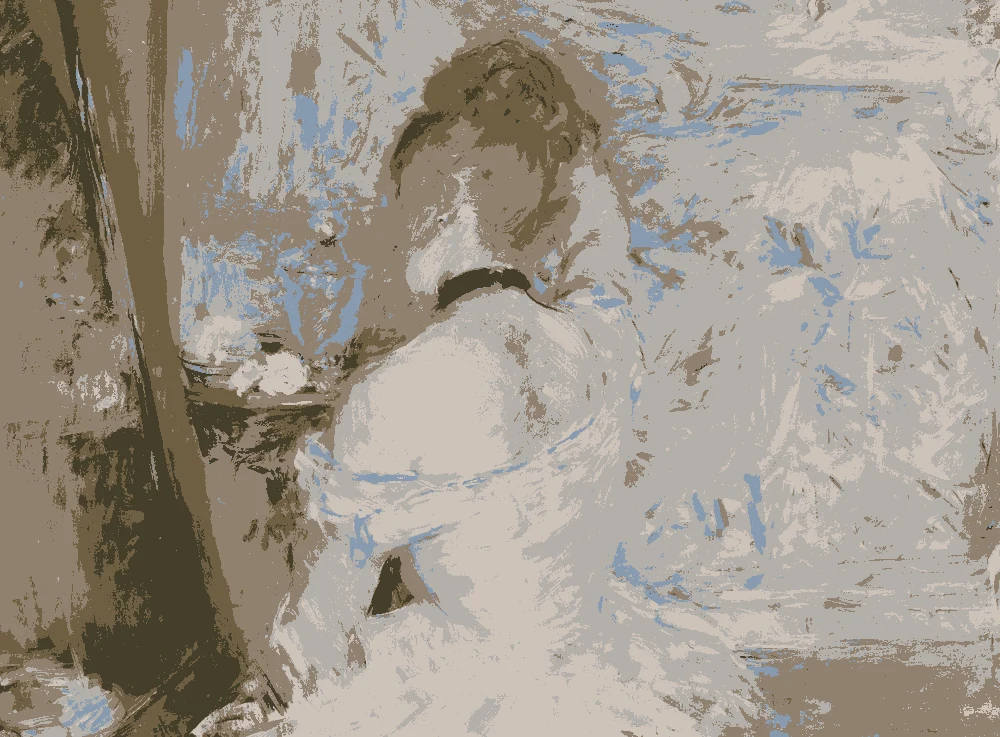
A light, neutral gray with an LRV of 43. Use it on a sofa, a cabinet run or a large rug, where you want presence without darkness. It was measured from Berthe Morisot's "Woman at Her Toilette" (1875–80, The Art Institute of Chicago).
A light color with a warm yellow undertone and an LRV of 66. It suits curtains, bedding and cushions, and softens cool walls. It was measured from Camille Pissarro's "Young Peasant Having Her Coffee" (1881, The Art Institute of Chicago).
A very dark, neutral color with an LRV of 1. Keep it to window frames, hardware, picture frames and thin details, because it absorbs nearly all light. It was measured from Jozseph Rippl-Rónaï's "Slender Woman with Vase" (1894, The Art Institute of Chicago).
A very dark brown with a warm yellow undertone and an LRV of 4. It is a good guide for wood floors, shelving or a dining table that grounds pale walls. It was measured from Gerard ter Borch the Younger's "The Music Lesson" (c. 1670, The Art Institute of Chicago).
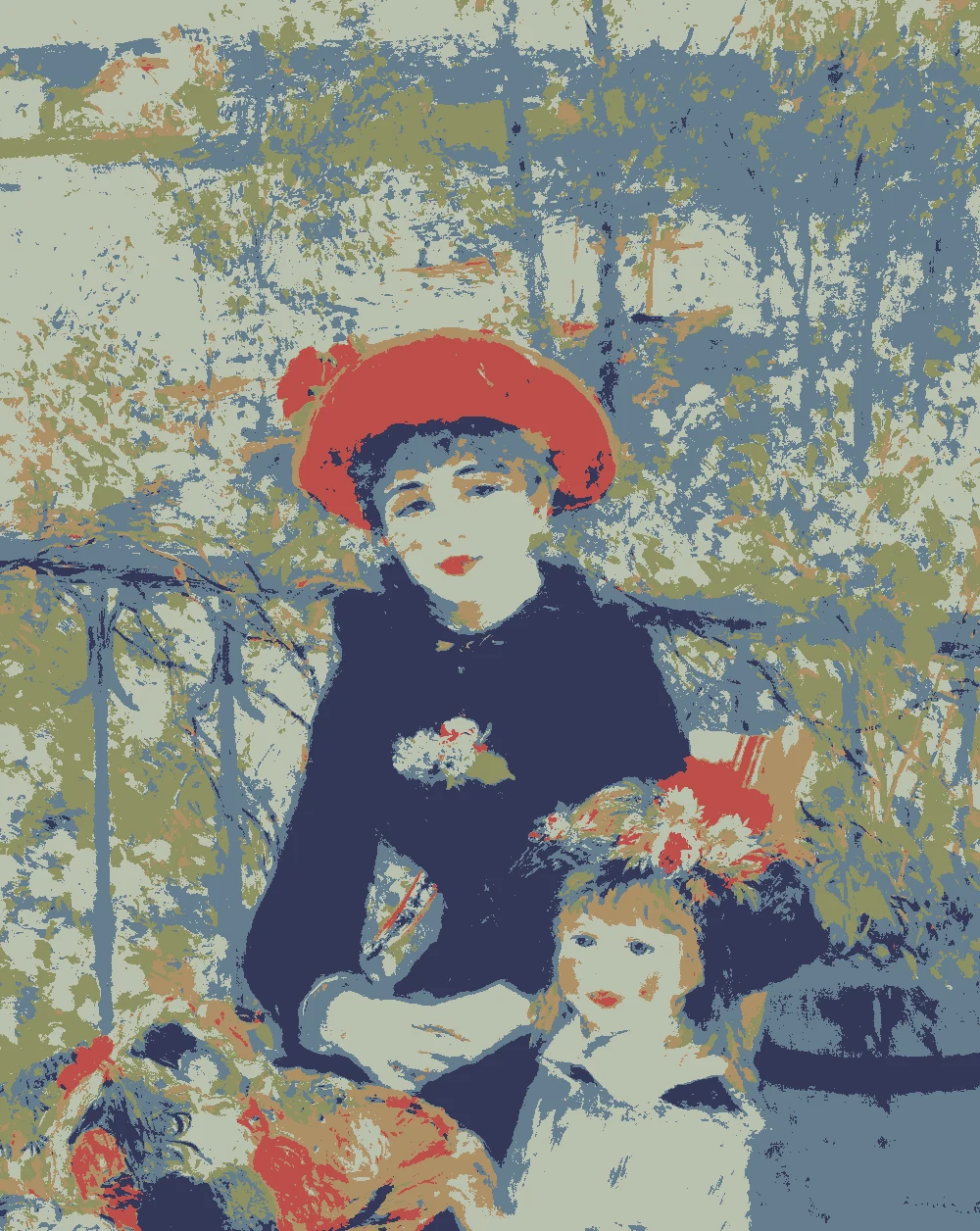
A mid-tone with a cool blue undertone and an LRV of 20. It makes a strong accent wall, front door or single armchair against the pale neutrals. It was measured from Pierre-Auguste Renoir's "Two Sisters (On the Terrace)" (1881, The Art Institute of Chicago).
The same paint reads differently in cool north light, warm south sun and under evening lamps. Find the column closest to your room.
Color
Neutral daylight
North light
South light
Evening lamps
Pale Mist Gray
Soft Stone Gray
Warm Linen
Try these colors in a room
Pick which color goes on the walls, the big furniture and the bold piece. Floors, shadows and trim follow your choice.
The framed picture on the wall is The Child's Bath.
How do you choose a modern room color from this palette?
Start with the walls. The lightest color, #DAE0E5, has an LRV of 74 and no clear undertone, so it reflects light and suits most rooms. For a slightly warmer feel, #DED2C4 has an LRV of 66 and a warm yellow undertone. Pick one of those two for the main walls.
Then choose the supporting colors. The mid-light gray #B3AFAA (LRV 43) works on larger furniture, such as a sofa or a run of cabinets, where you want weight without darkness. The blue-gray #657E8D (LRV 20) is the bold piece: one accent wall, a front door or a single armchair.
Keep the darkest colors small. #41382D (LRV 4) suits wood tones and a few fixtures. #0D100F (LRV 1) is close to black, and no close commercial match was found, so use it for metal, frames or a thin detail instead of a whole wall. Three or four of these colors in one room is plenty.
What goes with these colors: trim, ceiling and flooring?
Modern rooms usually keep the palette tight, so trim and ceiling should stay quiet. With #DAE0E5 walls, painting the ceiling and trim the same color gives a clean, continuous look, and the LRV of 74 helps bounce light upward. With #DED2C4 walls, the cooler #DAE0E5 on trim gives gentle contrast. Test the pair first, since the two differ in undertone.
For flooring, #41382D is a useful guide for dark wood. It is warm and deep, and it grounds light walls. If your floor is lighter, let #B3AFAA be the rug or large furniture color so the room is not all pale.
The blue-gray #657E8D pairs naturally with warm linen #DED2C4 in a textile, because the cool blue and the warm yellow undertone balance each other. Use #0D100F for window frames, lamp bases or hardware. For the closest paint matches measured, see Sherwin-Williams SW 6238 Icicle for the palest wall and SW 9183 Dark Clove for the dark brown.
How do modern house color schemes change with the light?
Light changes every color on this page. In a north-facing room, daylight is cooler and flatter. The neutral #DAE0E5 can look a little cooler there, so the warm #DED2C4 may feel more comfortable. In a south-facing room, light is warmer and brighter, and the cooler wall color keeps the space from leaning yellow.
LRV tells you how much light a color reflects. At 74 and 66, the two light colors brighten small or dim rooms. At 43, #B3AFAA sits in the middle and reads as a soft gray, not a light one. At 20, #657E8D reads dark, and at 4 and 1 the two darkest colors absorb most of the light. A whole wall in either will make a room feel smaller unless it has large windows.
Artificial light matters too. Warm bulbs push #DED2C4 and #41382D toward yellow. Cooler bulbs make #DAE0E5 and #657E8D look crisper. Check each color in the evening, not just at noon.
How do you test modern paint samples at home?
Samples settle the guesswork. Paint a large piece of poster board or a two-foot square on the wall, and leave a white border around it. Put one sample on each wall of the room, since each wall gets different light.
Look at the colors in the morning, at midday and in the evening, with the lamps you will actually use. Move the board next to the floor, curtains and main furniture. If you are weighing #DAE0E5 against #DED2C4, set them side by side and see which undertone suits the wood and fabrics you own.
Use the paint matches as a starting point. They are the closest ones measured, labeled very close, near-identical or close, and a screen cannot show the true color. Buy sample pots of the matches, such as Behr MQ3-26 Mainsail for the pale gray or Behr N240-2 Adobe Sand for the linen, and compare them to each other. For the near-black #0D100F, no close commercial match was found, so compare several dark samples side by side.
FAQ
What are good modern paint colors for a house interior?
Pale neutrals work best on walls, such as #DAE0E5 or #DED2C4. Add a mid-gray like #B3AFAA, a dark brown like #41382D for wood, and one deeper accent like #657E8D.
What is a good modern accent wall color?
The slate blue #657E8D is the strongest choice here. With an LRV of 20 and a cool blue undertone, it stands out against pale gray walls without turning black.
Which modern house color combination suits a small room?
Use #DAE0E5 on walls and ceiling for light, #B3AFAA on the main furniture and #41382D in the wood. Its LRV of 74 keeps the room bright, and the darker colors stay in small amounts.
Can I use black as a modern room color?
Yes, in small doses. #0D100F has an LRV of 1 and no close commercial match was found, so use it for frames, hardware or metal details, not whole walls.
Can these colors work as a modern color scheme for the whole house?
Yes. Keep the pale walls consistent from room to room, and change the accent: #657E8D in one room, #DED2C4 textiles in another. Test each color in every room, since the light differs.
Save these colors
A card with every color on this page, its LRV and the paintings it comes from. Pin it, or take it to the paint store.
Painting images: The Art Institute of Chicago, public domain (CC0).
Colors measured by Light & Pigment. Paint names belong to their brands and matches are approximate. Colors look different on screen than on a wall, so always test a sample.


 From The Child's Bath, Mary Cassatt