House exterior · Sage green · colors from 6 paintings
Sage Green House Exterior Colors: Four Complete Schemes
A sage green house works best when the walls, trim, front door and roof are chosen together. Below are four sage wall colors, from light and khaki to mid-tone and olive, each with a trim color, a front door color and a roof color. Every paint color was measured from a public-domain painting.
Quick answer
Use a sage with an LRV of 45 to 52 on a large house, and a mid-tone sage at LRV 19 to 30 on a ranch or bungalow. Pair it with a trim at LRV 70 or higher and a dark front door.
Every wall, trim and door color here was measured from one of these public-domain paintings.
4 complete exterior color schemes
Walls, trim, front door and roof together. Each scheme takes its colors from public-domain paintings, so the pairings are ones a painter already put side by side.
Khaki Sage Colonial
Walls #C6BFA4
Trim #D9E0D6
Front door & shutters #517C60
Roof: weathered wood
Light khaki sage walls with pale green-white trim and a deep green door and shutters suit a two-story colonial. The weathered wood roof matches the warm yellow undertone of the walls.
Mid-tone gray green walls with soft white trim and a dark walnut door and shutters give a ranch a calm, low-key look. The black roof keeps the color line simple.
Deep olive walls with light trim and an oxblood door and shutters suit a craftsman bungalow, where the strong trim contrast shows off the porch details. A black roof fits the dark walls.
Exterior paint is seen in much stronger light than a room. Full sun bleaches a color by a shade or two, while the shaded side of the house and overcast days pull it cooler and darker. Test a large sample on two sides of the house.
Color
Swatch
Full sun
Overcast
In shade
Golden hour
Warm Khaki Sage LRV 52
Gray Green Sage LRV 30
Soft Mint Sage LRV 45
Olive Moss LRV 19
Pale Sage Trim LRV 73
Try these colors on a house
Pick a color for the walls, the trim, the front door and the roof, and switch between house styles. Shadows and siding lines follow your choice.
Roof colors are typical shingle, tile and metal colors, not paint. Every other color comes from a painting on this page.
Colors for the walls
#C6BFA4LRV 52
Warm Khaki Sage
A light, warm sage at LRV 52 for the walls of a large house, where its yellow undertone suits a weathered wood roof. It comes from Toulouse-Lautrec's "Ballet Dancers."
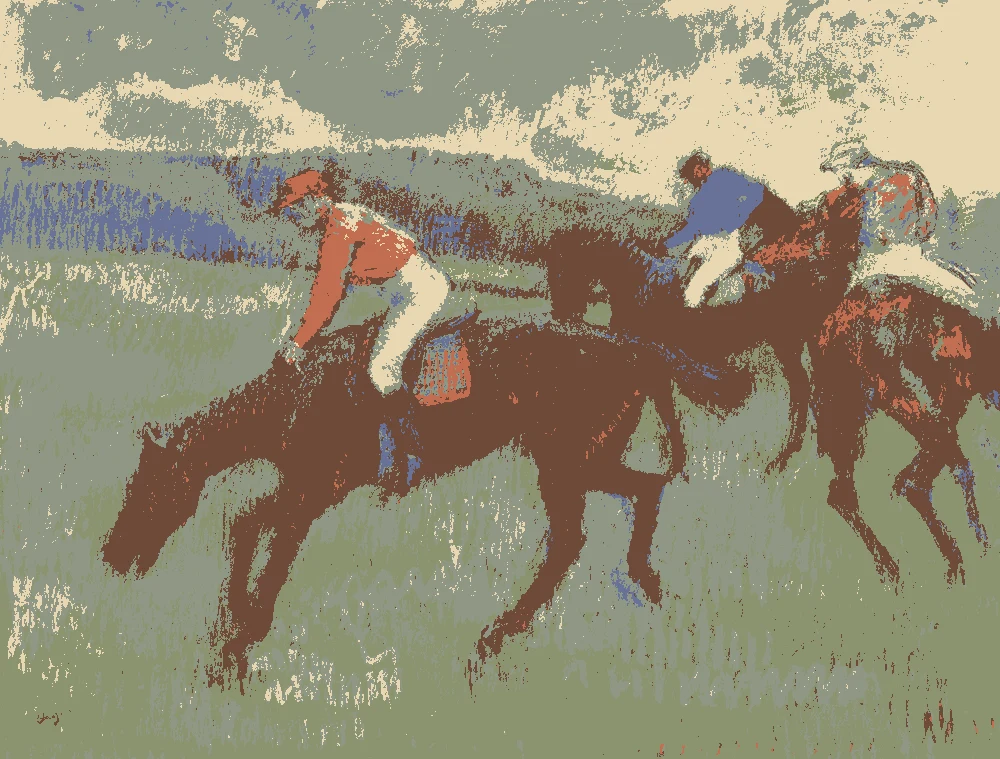
A mid-tone wall color at LRV 30 with a green undertone. It gives a ranch a calm, grounded look beside a black roof, and it comes from Degas's "Three Jockeys."
Sherwin-Williams SW 6455 Fleeting Green
Very close
Farrow & Ball No. 204 Pale Powder
Very close
#DBDAD1LRV 70
Quiet Green White
A very light trim at LRV 70 with a slight green cast, used on the ranch and the bungalow for fascia, window casings and the garage door. It comes from Hans Baldung's "Saint John on Patmos."
The lightest trim here at LRV 75, with no clear undertone. It keeps the soft green farmhouse walls looking clean, and it comes from Monet's "Boats on the Beach at Étretat."
Sherwin-Williams SW 6231 Rock Candy
Near-identical
Valspar 7004-16 Sheer Light
Near-identical
Behr 790A-2 Ancient Stone
Near-identical
Farrow & Ball No. 235 Borrowed Light
Very close
Front door and shutter colors
#517C60LRV 17
Deep Fern Green
A deep green door and shutter color at LRV 17 that stays in the same family as the khaki sage walls. It comes from Toulouse-Lautrec's "Ballet Dancers."
A very dark brown at LRV 4 for a front door and shutters on mid-tone walls. Its warm yellow undertone softens a black roof. It comes from Hans Baldung's "Saint John on Patmos."
A deep red-orange at LRV 18 that stands out against light green walls and makes a clear focal point at the front door. It comes from Monet's "Boats on the Beach at Étretat."
Start with what will not change. A roof, a brick foundation, stone steps and a chimney all have their own color. The wall color has to agree with them, so look at their undertone first.
Warm sages with a yellow undertone, such as #C6BFA4 and #807B4E, sit comfortably next to a weathered wood roof, tan brick and warm stone. Sages with a green undertone, such as #A4B9A8 and #8F9785, suit a black or charcoal roof and gray stone.
Then think about the house itself. A light sage with an LRV of 45 to 52 keeps a large house from feeling heavy. A mid-tone or dark sage, at LRV 30 or 19, gives a low ranch or bungalow more presence. Each scheme on this page pairs one wall color with one roof color, so you can see a full combination before you buy a sample.
How much contrast should trim and the front door have?
Trim should be clearly lighter than the walls. The trim colors here have an LRV of 70 to 75, and the wall colors run from 19 to 52. The wider the gap, the crisper the house looks. The ranch walls at LRV 30 and the bungalow walls at LRV 19 contrast most with their trim. The colonial, with walls at LRV 52 and trim at 73, has a softer edge.
Use the trim color on fascia, window casings, corner boards and the garage door. A garage door in the trim color is less likely to pull the eye.
The front door and shutters go the other way. Doors at LRV 4 to 18 are much darker than the walls, so they become the focal point. Keep the door and shutters to one color. A deep green, a dark brown, a terracotta red and an oxblood each give a different mood against sage.
Why does sage green look different in sun and shade?
Outdoor light is stronger than indoor light. In full sun, a sage tends to look lighter and a little more washed out than the small chip suggests. In shade, or on a north-facing wall, the same color looks cooler, grayer and deeper.
A whole house is also a very large area of color, and large areas tend to look lighter and stronger than a card does. For that reason, choose a shade darker than the one you think you want. If you like a color at LRV 45, look closely at the one next to it at LRV 30.
Undertone matters here too. A warm yellow undertone can keep a shaded wall from turning too cool. A green undertone will look cooler in shade, so check it on the shadiest side of the house before you commit.
How do you test sage green samples on a house?
Do not decide from a chip. Paint sample boards at least two feet square, or paint a patch directly on the siding. Put on two coats so the color is even.
Test on at least two sides of the house, ideally one that gets morning sun and one that sits in shade for most of the day. Prop the boards next to the roof, brick, trim and front door color you plan to use, so you judge the whole combination and not one color alone.
Look at the samples in the morning, at midday, in late afternoon and on an overcast day. Check them again at dusk, with the porch light on. Live with them for a few days. The color that still looks right on every side and in every light is the one to paint.
FAQ
What color trim goes with a sage green house?
A very light trim with an LRV of 70 to 75 works well. The schemes here use a pale green-white, a quiet green-tinted white and a cool neutral white, all lighter than the walls.
What front door color looks best on a sage green house?
A deep or very dark color gives the clearest contrast. Deep fern green, dark walnut brown, terracotta red and oxblood red are all shown here, each with an LRV of 4 to 18.
What roof color goes with a sage green house?
The schemes pair weathered wood with the warm khaki sage, black with the gray green and olive walls, and charcoal with the soft mint sage. Match the roof's undertone to the walls.
Should I choose a light or dark sage for the exterior?
Light sages at LRV 45 to 52 suit large houses and look brighter in sun. Darker sages at LRV 19 to 30 suit ranches and bungalows. Outdoors, choose a shade darker than you expect.
What makes a good sage house color scheme?
A good scheme has four parts that agree: a sage wall color, a lighter trim, a darker front door and shutters, and a roof that matches the wall's undertone. Test the full set on the house before you paint.
Save these colors
A card with these house color schemes: walls, trim, front door and roof. Pin it, or take it to the paint store.
Painting images: The Art Institute of Chicago, The Metropolitan Museum of Art, public domain (CC0).
Colors measured by Light & Pigment. Paint names belong to their brands and matches are approximate. Colors look different on screen than on a wall, so always test a sample.