Green works outside because it sits easily beside trees, lawns and stone. This page shows four complete green exterior schemes, each with wall, trim, front door, shutter and roof colors measured from a public-domain painting. Every color has its LRV and the closest commercial paints.
Quick answer
Use a sage or olive green with an LRV of about 19 to 51 on the walls, a cream or cool white trim at LRV 73 to 76, and a dark or deep front door in umber, navy or teal. Add a charcoal or black roof.
Every wall, trim and door color here was measured from one of these public-domain paintings.
4 complete exterior color schemes
Walls, trim, front door and roof together. Each scheme takes its colors from public-domain paintings, so the pairings are ones a painter already put side by side.
Sage and Cream Colonial
Walls #96AA96
Trim #E8DDC8
Front door & shutters #967F5B
Roof: charcoal
Soft sage walls with warm cream trim and a tan brown door and shutters suit a two-story colonial. The charcoal roof keeps the look calm.
Dark olive walls with cream trim and an umber door and shutters give a long, low ranch a strong outline. The black roof matches the depth of the walls.
Pale olive walls with cool green-white trim and a deep teal door and shutters suit a craftsman bungalow. The black roof gives the light walls a firm top edge.
Exterior paint is seen in much stronger light than a room. Full sun bleaches a color by a shade or two, while the shaded side of the house and overcast days pull it cooler and darker. Test a large sample on two sides of the house.
Color
Swatch
Full sun
Overcast
In shade
Golden hour
Soft Sage Green LRV 37
Smoky Olive Green LRV 19
Fresh Moss Green LRV 22
Pale Olive Khaki LRV 51
Warm Cream White LRV 73
Try these colors on a house
Pick a color for the walls, the trim, the front door and the roof, and switch between house styles. Shadows and siding lines follow your choice.
Roof colors are typical shingle, tile and metal colors, not paint. Every other color comes from a painting on this page.
Colors for the walls
#96AA96LRV 37
Soft Sage Green
A mid-tone wall color with an LRV of 37, light enough to keep a two-story house from looking heavy. It comes from "Nantasket Beach" by Emil Carlsen, 1876, at The Art Institute of Chicago.
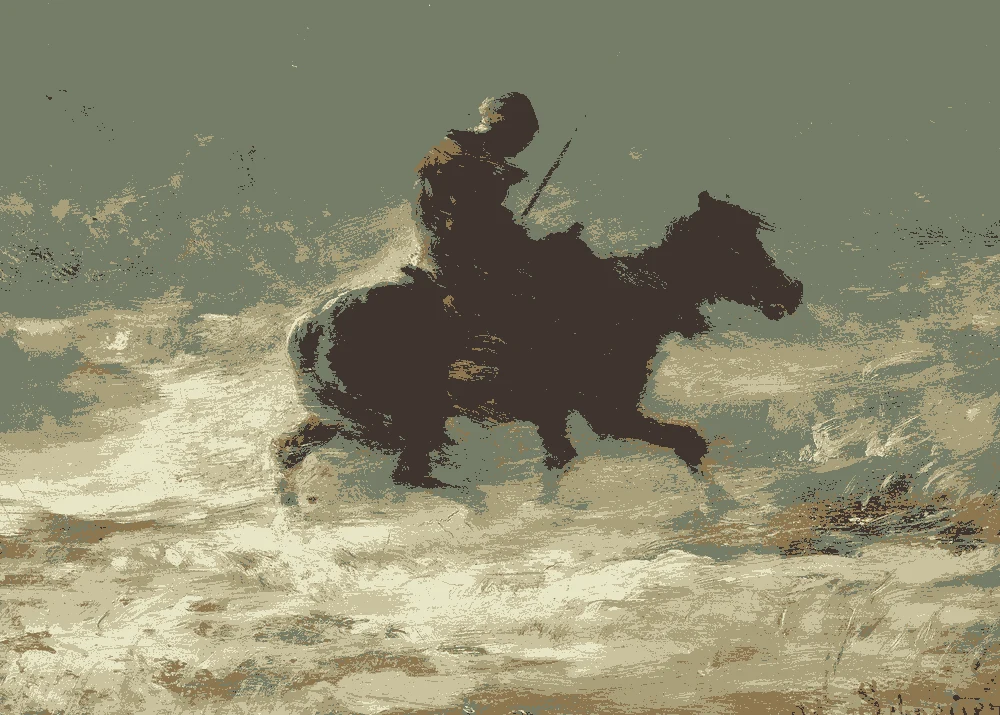
At LRV 19 this green reads dark, so it suits a ranch or a house set among trees. It is measured from "Man with Lance Riding through the Snow" by Adolphe Schreyer, c. 1880, at The Art Institute of Chicago.
A mid-tone green with LRV 22 that has more color than the sage or olive, which makes it a good fit for a farmhouse in full sun. It comes from "Arlésiennes (Mistral)" by Paul Gauguin, 1888, at The Art Institute of Chicago.
A light green-khaki with a warm yellow undertone and LRV 51. It bounces more light than the other wall colors and pairs well with warm stone or tan brick. It is measured from "Olive Trees" by Vincent van Gogh, 1889, at The Metropolitan Museum of Art.
A very light trim color with a warm yellow undertone and LRV 73. Use it on trim, fascia and the garage door. It comes from "The Garden of the Tuileries on a Winter Afternoon" by Camille Pissarro, 1899, at The Metropolitan Museum of Art.
Sherwin-Williams SW 6119 Antique White
Near-identical
Valspar 7003-9 Malted Milk
Near-identical
Behr PPU8-14 Silky Bamboo
Very close
#E2E3D8LRV 76
Cool Green White
A very light trim color with a green undertone and LRV 76, the lightest trim here. It keeps a lighter wall color crisp. It is measured from "Icebound" by John Henry Twachtman, c. 1889, at The Art Institute of Chicago.
Farrow & Ball No. 252 Pavilion Blue
Near-identical
Valspar 7006-8 Divine Cream
Very close
Behr HDC-NT-24 Glacier Valley
Very close
Sherwin-Williams SW 6182 Ethereal White
Very close
Front door and shutter colors
#967F5BLRV 22
Warm Tan Brown
A mid-tone front door and shutter color with a warm yellow undertone and LRV 22. It looks natural against sage green. It comes from "The Garden of the Tuileries on a Winter Afternoon" by Camille Pissarro, 1899, at The Metropolitan Museum of Art.
A very dark door color at LRV 3 with a warm yellow undertone. It gives strong contrast against a mid-tone green and cream trim. It is measured from "Study of Water and Plants" by Thomas Fearnley, 1837, at The Metropolitan Museum of Art.
A very dark, cool blue door at LRV 5, a clear contrast to a warm yellow-green wall. It comes from "Arlésiennes (Mistral)" by Paul Gauguin, 1888, at The Art Institute of Chicago.
A deep, cool blue-green door and shutter color with LRV 15. It stands out against pale olive walls without turning harsh. It is measured from "Icebound" by John Henry Twachtman, c. 1889, at The Art Institute of Chicago.
How do you choose green exterior house colors for the walls?
Start with what will not change. A roof, brick, stone or a concrete foundation has its own color and undertone, and the wall green has to sit comfortably beside it. Look at those materials in daylight and decide whether they lean warm or cool.
Warm, yellow-leaning stone or tan brick suits a green with a yellow undertone, like the pale olive khaki here at LRV 51. A charcoal or black roof works with every green on this page. Cool gray stone sits better beside the sage at LRV 37 or the smoky olive at LRV 19.
Then think about size and surroundings. A mid-tone green like the sage keeps a large house from looking heavy. A dark green around LRV 20 blends into trees and suits a ranch or farmhouse set among plantings. Pick the wall color first, then trim, then the door.
How much contrast should trim and the front door have?
Trim frames the house, so its contrast with the wall sets the mood. Light trim against a mid-tone or dark green gives a crisp outline. The three deeper wall greens here sit between LRV 19 and 37, and the trim is LRV 73 to 76, so the edges read clearly.
The pale olive khaki at LRV 51 has a smaller gap, which is why it is paired with the lightest trim, LRV 76. Use one trim color on fascia, window casings, corner boards and the garage door so the house reads as one piece.
The front door is where you can go dark. A very dark door, LRV 3 to 5, in umber or navy looks calm against green. A deep teal at LRV 15 or a warm tan brown at LRV 22 is softer. Paint the shutters the same color as the door, and hold the door sample next to the trim sample before you decide.
Why does green house paint look different in sun and shade?
Outdoors, color changes through the day. Full sun adds so much light that a green looks lighter and often warmer than the chip. A mid-tone like the sage at LRV 37 can look pale on a south or west wall at midday. Walls in shade look cooler and deeper, and the same green can lean gray or blue.
Because of this, choose a shade darker than you think you want. A chip that looks right on a table often looks washed out once it covers a whole wall in sun.
Large surfaces also look stronger than small ones. A dark green near LRV 20 reflects little light, so it reads rich in sun and nearly black under heavy tree cover. If the house sits in deep shade, lean toward the lighter end, such as the khaki or the sage, so it does not disappear.
How do you test green exterior paint samples?
Test on the house, not on a chip. Paint two large samples, at least two feet square, on primed boards or directly on the wall. Use real paint, not a printed card. Leave a white border around each so you judge the color alone.
Put one sample on the sunniest side and one on the shadiest side. Place them next to the trim, roof or brick that will stay. Look at them in the morning, at midday, in late afternoon and on an overcast day.
Hold the trim and door samples beside the wall sample. Check the green against the roof shingle and any stone. Live with the samples for a few days before you decide. If two greens are close, pick the darker one, since sun will lighten it. The paint matches on this page are the closest measured, so confirm the color on your own wall.
FAQ
What is the best green for a house exterior?
It depends on your light, roof and surroundings. A mid-tone sage around LRV 37 is soft and easy to live with, and a smoky olive near LRV 19 blends into trees.
What trim color goes with green house paint?
A warm cream white at LRV 73 suits most greens, and a cool green-white at LRV 76 keeps lighter olive walls crisp. Use one trim color on trim, fascia and the garage door.
What front door color goes with a green house?
Dark umber, deep navy and deep teal all work, as does a warm tan brown. The very dark ones, LRV 3 to 5, give the strongest contrast.
What roof color works with green exterior paint?
Charcoal and black roofs suit every green scheme on this page. If your roof is staying, hold your samples next to it before choosing.
Do green exterior colors look different in sun and shade?
Yes. Green looks lighter in full sun and cooler and deeper in shade. Choose a shade darker than you expect and test large samples on two sides of the house.
Save these colors
A card with these house color schemes: walls, trim, front door and roof. Pin it, or take it to the paint store.
Painting images: The Art Institute of Chicago, The Metropolitan Museum of Art, public domain (CC0).
Colors measured by Light & Pigment. Paint names belong to their brands and matches are approximate. Colors look different on screen than on a wall, so always test a sample.